1970-1979
The seventies saw an explosion of library activity throughout the state, as well as at the Nebraska Library Commission. The Commission budget increased from $132,500 in the 60s to $165,445 in 1972. Continuation of LSCA funding for construction was still a major function. There was a need for networks or multi-regional divisions to provide equitable library services to the people of Nebraska. Space needs, particularly for the juvenile department, continued to plague the Commission.
Dr. Robert Kemperaccepted the job of Executive Secretary in 1971. Some of the projects that were notable during his tenure included the Library "Know Series", Nebraska's Library Year with the theme of Go Big Read, People Serving People, Nebraska Publications Clearinghouse, and Nellie.
The Library Commission partnered with the State University of Nebraska in a program (The S.U.N. Project) to establish mini-centers in libraries throughout the state. The idea was to make lists of materials available in the public libraries. Courses would be available to persons of all ages. There were no admission requirements. (Overtones, v. 2 #5)
A Legislative Open House was held January 27, 1972. (Minutes, December 1971, p. 82). Informal meetings with the members of the Legislature became something of an annual event. The purpose was to acquaint the legislators with library services and the people who deliver those services. The fourth legislative luncheon, held March 14, 1973, (Overtones from the Underground, v.1, #19) turned out to be a non-legislative luncheon when an emergency Appropriations Committee meeting was called.
LB1033 changed the 5-member Commission to a 6-member Commission. The name of the Commission was changed to Nebraska Library Commission. The word "public" was dropped to reflect the expanded mission of the agency.
LB1284A-LB1284 created the Nebraska Publications Clearinghouse and declared the Library Commission as the agency responsible for receiving state and federal publications.
There was some movement in the Legislature to merge the Nebraska Library Commission with the State Department of Education. The issue was over division of federal funding and who would be the responsible agency. The matter was resolved without resorting to legislation. President Nixon's zero financing of all federal library funding effectively shut down LSCA programs.
People Serving People was a long-range plan with its beginnings in 1972. Its stated purpose was to serve as the beginning of an on-going process that would move toward the goal of total library service for each Nebraskan. "The implementation of total library service for each Nebraskan will need the total involvement of all local school districts, the Nebraska Library Association, the Nebraska Educational Media Association, academic institutions, and so forth." (Kemper: People Serving People, p. 6-7)
The Commission moved from the Capitol in 1973. The move was triggered by the construction of the State Office Building. Correspondence from the time suggests that there was no space provided for the Commission in the new facility. After much discussion with the state Department of Administrative Services space was found at 1420 P Street and the move was completed.
The Empathetic Library Service Institute (1973-74) (ELSI) was developed to meet the needs of the Nebraska Long Range Plan, People Serving People. The goals of the Institute were to develop the participants' skills in identifying human needs, to develop skills in planning programs of library service, to implement these programs and to develop leadership abilities. Empathetic Library Services Institute was funded by HEA Title II B grant to communicate the happenings of Overtones from the Underground ELSI (v.1, #1).
The Nebraska Library Commission received a check for $7,621.54, a bequest of the Dora Reeves Estate "for the benefit of blind persons." The Reeves were early settlers in Sheridan County and retired to Rushville. Mr. Reeves became blind and was the recipient of talking books from the Library for the Blind and Physically Handicapped. Mrs. Reeves expressed her desire to help other blind people through the Library and the bequest from her estate was the result. (Overtones from the Underground, v.1, #7, 1973)
Kemper resigned in 1973. Jane Geske assumed the position of acting
Interim Secretary and was appointed Director of the Nebraska Library Commission in 1974. She held the post until 1976 when she retired. John Kopischke followed her as the next
Director.
The Library for the Blind and Physically Handicapped was moved to 1420 P Street in 1974 to become physically part of the Nebraska Library Commission. Space and accommodation for its customers' needs made the move practical. Although a part of the Commission it had been housed at 1047 South Street since 1971.
The Commissioners discussed the feasibility of incorporating all six networks. There were varying opinions on incorporation. A committee was formed at the Regional TWX librarians meeting in November of 1976 to further study this possibility (Min. 1960-1979, p. 150). John Kopischke reported at the November 30, 1976 meeting of the commissioners that all six networks were incorporated.
The Commission observed 75 years of service to the people of the state in 1976 by analyzing its progress and goals, reviewing the past and preparing for the governor's conference in 1976. [Diamond Jubilee celebration, Overtones v3, #1 Aug 22, 1975]
Dorothy Lessenhop retired from the commission in 1975 after 40 years of service. She was hired "sight unseen" by Nellie Williams (Executive Secretary) in 1935 fresh out of college. Coming from Toledo, she said she planned on staying two years and ended up spending the rest of her life in Nebraska. Her jobs at the Commission ranged from reference librarian, librarian for the blind, and head of circulation to acting Executive Secretary.
John Kopischke (1976) stepped into a program that was moving forward rapidly. In the Overtones from the Underground (v.3, #24) Kopischke stated "Climbing into the driver's seat at this point in the Commission's travels must be a little bit like jumping onto the running board of a rocket: the panorama is dazzling and the speed is exhilarating, but the flight plan takes awhile to perceive."
LB661 introduced in 1976 was of great concern because it was an act to transfer the Library for the Blind and Physically Handicapped to the Department of Public Institutions. It was designated as an "emergency" bill, which would make it effective immediately upon passage. The Library Commission presented a position paper in opposition to the bill on the grounds that the bill did not sufficiently address the need to provide for total library services to all Nebraskans regardless of the specialization of the need. The bill did not pass.
The Nebraska Library Commission, the Nebraska Library Association and the Nebraska Educational Media Association, along with citizens were key players in implementing a survey to determine what the people's perception of library needs was, compiling the information, and planning the conference. In 1975 a converted bookmobile, dubbed The Information Powermobile (Overtones, v.2 #20) toured the state gathering ideas for topics.
Governor J. James Exon's pledge of support given at the Nebraska Library Association's conference in 1973 set the wheels in motion for the Governor's Conference on Library Services in 1976. The theme "The Citizen Challenge" emphasized Exon's wish that the delegates be composed mainly of non-librarians. Much effort went into the planning and implementation of this conference. The aim of the conference was to bring a variety of delegates from all walks of life and representing all areas of the state. They also brought to the conference a commonality of issues.
The Hilton Hotel was the setting for the two-day conference held April 27-28, 1976. Nearly 300 delegates met to discuss issues and suggest remedies. Governor Exon welcomed the group. Fifteen different discussion groups spent the time talking issues and making suggestions for solutions to the problems.
Children's services have always been a part of the Commission's services. From the early days booklists for school children were sent to schools, program ideas for Children's Book Week were developed, Nellie Williams made her plea for "good books," as well as the continuing support for the ever-popular summer reading program. In 1976 negotiations were begun with Keene Memorial Library to serve as the State Juvenile Resource Collection for all Nebraska Public Libraries. Guidelines were developed to govern the scope of the collection
In 1978 the Toybrary program, a project of the Special Education Branch of the Nebraska Department of Education with the help of the Regional Libraries in Nebraska, became a reality. The goal was to provide developmental toys, along with a brochure suggesting learning activities, to parents across the state to aid in providing educational outreach services for Nebraska's young handicapped children.
Automation of services continues in this decade. The TWX service of the sixties heralded a quicker way of accessing Interlibrary Loan. NEUCAT in 1979 put the Union Catalog holdings on microform. The holdings of the 52 Nebraska libraries that participated in the Union Catalog were transferred to microform by processing OCLC tapes. NEUCAT was primarily an improved Interlibrary Loan tool, but it had other uses as well. It could be a valuable tool for cooperation in collection development. It could provide cataloging data. The future of NEUCAT was seen as becoming an on-line version.
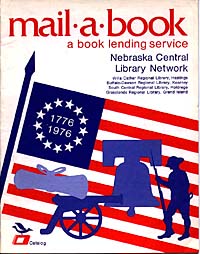
Meanwhile, back at the office, things were progressing on a more traditional road. The Mail-A-Book program was supplying people with books through the postal service.
Minimum standards for libraries were set in the middle 50s and enlarged upon in the 60s. In 1974 these were revised and upgraded into a more comprehensive program for providing quality service to the citizens of the state. Libraries were assigned to one of nine steps according to population. The guidelines suggested minimum structure and governance, trustee terms and responsibilities, services provided, collection development, personnel, and physical facilities. Acceptance of these guidelines was voluntary. Standards remained the same until the next decade.
The Pre-White House conference (1979) was designed to build on the Governor's Conference of 1976 and to lead up to the White House Conference in 1979. "Speakouts" were designed to obtain local citizen ideas about library services that can be used in designing a state and national policy for library and information services. Recommendations on library policies and services would be taken by the delegates to Washington D.C.
101 delegates met in Lincoln on March 29-31, 1979 to tackle the issues of service to the state. The Pre-White House Conference eventually adopted twenty-four recommendations about library and information services. They also elected seven delegates and three alternates to represent Nebraska at the national meeting in Washington.
Delegates elected to attend the White House Conference were Bertha Calloway, Omaha; Ellen Lierk, Alliance; Ray Means, Omaha; Robert Newman, Omaha; Jerome Rakov, Verdigre; Eileen Wirth, Omaha, and John Kopischke, Lincoln. Kopischke stepped down to become an alternate since as Director of the Commission he was to be there. Robert Braude, Omaha took his place. The three alternates were John Kopischke; Joseph Johnson, Anselmo; and Vondra Abbott, Blair.
The decade ended with a rousing finale-The White House Conference of 1979.
"In November, more than 3,200 people converged on Washington, D.C. to participate in the culmination of over two decades of dreaming, thinking, striving, and planning. . . . The final sessions. . . generated sixty-four resolutions, twenty-five passed in general session and thirty-nine voted on by paper ballot." (The White House Conference on Library and Information Services One Year After-A Report to the Nebraska Library Commission, Braude)
This was not the end of work to be done. Committees met to work out the details of how to implement the resolutions. Some were to be acted upon right away; others would need more time to develop.