1900-1909
The stated purpose of the HR 20 (1901) was to "create a Public Library Commission, to define its duties; to establish traveling libraries and make an appropriation therefore." "The Governor shall appoint one person for a term of five years who with the State Librarian, the Superintendent of Public Instruction, The Chancellor and Librarian of the University of Nebraska shall constitute the Nebraska Public Library Commission." (HR 20)
The newly created Public Library Commission became the 20th state to join the array of Public Library Commissions in the country. (1st Biennial Report, p. 3) The first board members were: E. Benjamin Andrews, Chancellor; J.I. Wyer, Jr., University of Nebraska Librarian; Lee Herdman, State Librarian; W.K. Fowler, Superintendent of Public Instruction; and F.L. Haller, Omaha Public Library, Governor appointee. This group met and elected J.I. Wyer as president. Edna Bullock (see below) was hired to serve as the first Executive Secretary (later called Director) and instructed to report for duty not later than October 1, 1901. Salary for Bullock was set at $1,000.
The Commissioners scheduled regular meetings twice a year, one in the spring and one in the fall. Special meetings would be called as needed.
Space for housing the new Commission was not to be found "below the third floor of the State Capitol." Meetings of the board were held in the office of the state superintendent of public instruction. Expenses for setting up the office were allowed. Rules were formulated for the development of the Traveling Libraries. The office was opened on November 11, 1901. Room was finally found in the basement of the Capitol to set up operations. A meeting room for the board continued to pose a problem, particularly when the legislature was in session.
One of the primary goals of the Commission was to encourage the growth and spread of public libraries in the state. To this end, the Traveling Library concept was implemented. Towns were encouraged to apply for the loan of a traveling library. Loup City was the first mobile library sent out by the Commission. (Lincoln Journal Star, Dec 22, 1991) A description of traveling libraries in Nebraska was included in the Second Biennial report of the Nebraska Public Library Commission, Nov. 30, 1904. Later, the establishment of "permanent" stations became a goal of the Commission. In this way, patrons who used the traveling libraries could be assured of having books available on a regular basis. Special loans were made to women's clubs in return for their having donated books for study purposes. In return, these clubs supported legislative appropriations for the Commission in 1905.
A Circular of Information and a State Fair Circular were printed early in the life of the Commission for distribution around the state. The Commission was aware of the needs of the rural population and created a special Farm Circular with suggestions for creating a reading atmosphere in the home. A list of books appropriate for young people was added with suggested book dealers.These circulars helped promote the services of the Public Library Commission. Booklists were compiled to help town libraries and school libraries with the selection of material that was appropriate for them to purchase. The first Nebraska Library Bulletin was issued in February 1906, ". . . published in the interests of more and better libraries in Nebraska . . . mailed free to libraries and library trustees of the state."
A resolution was passed on November 9, 1904, "that this Commission heartily concurs in the spirit of the suggestion that a library be presented by the people of the state to the battleship Nebraska, and places its services for securing, preparing and installing such a library, at the disposal of any committee properly appointed to manage such an undertaking." (Minutes, p. 14)
Another important aspect of the work of the Commission was the development of study courses for librarians. The Commission saw the need to improve the skills of those persons who were in charge of libraries so that proper library procedures would be used.
"By 1904 the Commission began to distribute information on summer school opportunities." "In 1906 the Commission started a correspondence course for librarians. This was a twenty-lesson course emphasizing library management." (Svoboda History) Also in 1906 the first Nebraska Library Bulletin was issued by the Commission, " . . . published in the interests of more and better libraries in Nebraska . . . mailed free to libraries and library trustees of the state."
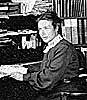 Edna Bullock (left) served as Executive Secretary until 1906. During her tenure she was elected President of the Nebraska Library Association. She later worked with H.W. Wilson Company as editor. She returned to the state become librarian for the Nebraska Legislative Reference Bureau, a post she held from 1911-1921.
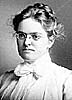 Charlotte Templeton (right) succeeded Miss Bullock as the second Executive Secretary in 1906.The reading health of the inmates of the state's institutions greatly concerned Templeton. She made it one of her priority programs as long as she was at the Commission.
The beginning of the new decade foreshadowed a rapidly growing Library Commission, in dollars and in the number of people served.